
Moral disengagement in the pro-choice movement
At the moment of conception, the unborn human is a unique, individual human being distinct from the mother and father, with his or her own DNA. Therefore, in question is a separate human, who is neither the father nor the mother. Consequently, the termination of a pregnancy is the ending of the life of this person, which would thus be characterised as killing. Indeed, in society, some killing is condoned, such as in the case of capital punishment or in the context of war. However, in the case of an unborn child, the child is innocent of wrongdoing, vulnerable and has not chosen their presence in an unwanted womb. Therefore, consistently applying the moral standards on killing, the abortion of an unborn child is deeply immoral and unjust. The immorality and injustice of abortion are clearly and vocally defined and prescribed by the Holy Catholic Church. In the face of such immorality, how does the pro-choice (or pro-abortion) movement foster nurturing support for abortion with moral realities of right and wrong?
Moral disengagement is a theory that explains the justification of immoral behaviour by an individual through a process, where the mind ‘disengages’ ethical standards for a specific issue (Bandura, 1999). This could also be the case in the logic of morality, where harmful conduct may be viewed as moral in some cases but immoral in others. In the pro-choice movement, this would be exemplified in the inconsistent standards against killing, which are not applied to the evaluation of abortion. The disapproving view of oneself as acting inconsistently with moral standards (called self-sanctions) can be selectively engaged and disengaged (Bandura, 2001). In ordinary circumstances, this self-sanctioning functions in dissuading the individual from engaging in harmful conduct (Bandura, 2001). However, this disengagement of self-sanctioning would be necessary for a logical individual in order to justify the acceptance of abortion, in order not to view oneself in a negative light for applying morality incoherently.
How can moral disengagement take place let alone at the individual level, but also at a societal level? To answer this, we will consider a number of psychological mechanisms employed in the pro-choice abortion discourse, namely, moral justification, advantageous comparison, misrepresenting the harm, euphemistic language, dehumanisation, and social categorisation.
Moral justification
The moral justification of abortion by the pro-choice movement is a significant aspect of making the practice societally acceptable. Moral justification relates to the reconstruction of an act from immoral to acceptable (Bandura, 1999). Obviously, morality cannot be redefined, thus, abortion cannot be redefined as moral, however, moral justification attempts to distort the perception of the act as not just moral, but a commendable social cause.
Moral reasoning could take the form of deontological or consequentialist arguments; a deontological argument refers to rights and justice, while a consequentialist argument relies on welfare (Kreps & Monin, 2014). A deontological argument for abortion focuses on justifying the act of abortion itself with moralistic claims and may state that abortion is a women’s human right (Kreps & Monin, 2014). This argument redirects the focus on morals from the unborn child’s moral right to live to a women’s rights issue, thus, justifying the act of abortion.
Vetlesen (2019) theorises a concept of a ‘narrative of entitlement’, which helps understand how engagement in a harmful act may be framed as a right and duty, thus can often be framed in the language of human rights, or more specifically women’s rights. Therefore, when abortion is referred to as a right, it is stated that a woman, and women as a group, have the right, and the entitlement, to seek an abortion.
On the other hand, a consequentialist argument for abortion focuses on the outcomes, rather than the act itself (Kreps & Monin, 2014). This includes the statement that women will have abortions anyway, thus, abortion must stay legal so that it remains safe. This argument, although related to morals, has a pragmatic frame, since it draws on cost-benefit considerations (Kreps & Monin, 2014). It does not evaluate whether abortion in itself is right or wrong, rather that it is morally acceptable because it is more beneficial for women to keep it legal. Another consequentialist argument would justify abortion through the perceived benefits of acquiring it, such as being able to focus on her career, or better take care of her other children. Basically, the ends justify the means.
Advantageous comparison
A tool for moral disengagement is identified as ‘advantageous comparison’, which usually takes the form of comparing an immoral act with an extremely immoral act, thus, making it seem not that bad (Bandura, 2001). This is often done in the abortion debate to present abortion as a lesser of two evils. For instance, the case of conception through rape is brought out consistently, although a minority of the cases of abortion, in reality, relate to rape, which offers abortion then as a more compassionate option.
Another case of advantageous comparison does not compare abortion to a worse action but attempts to create positive associations with abortion by presenting abortion as righteous through affiliation to causes for the emancipation of women. It is illustrated as a question of freedom, feminism, and human rights, which all hold positive connotations in society. Therefore, a comparison of desirable and admirable terms and standards equates the issue of abortion to other social justice issues.
Misrepresenting the harm
Misrepresentation of harm in the pro-choice debate takes the form of minimising or completely disregarding the consequences of abortion. In reality, abortion causes mental and physical harm to the woman, and therefore, the disregard for these negative consequences of abortion enables society to avoid facing the harms abortion causes to the women. This disregard for the negative consequences may fuel the continuing support for abortion as a desirable option for women, despite the discrepancy with reality. On the other hand, the possible harm of pregnancy and motherhood are widely discussed and utilised in the abortion debate to highlight abortion as a better option. It is significant to note that these harms of pregnancy and motherhood are often based on selfish assumptions, where a women’s convenience trumps the child’s right to life.
Euphemistic language
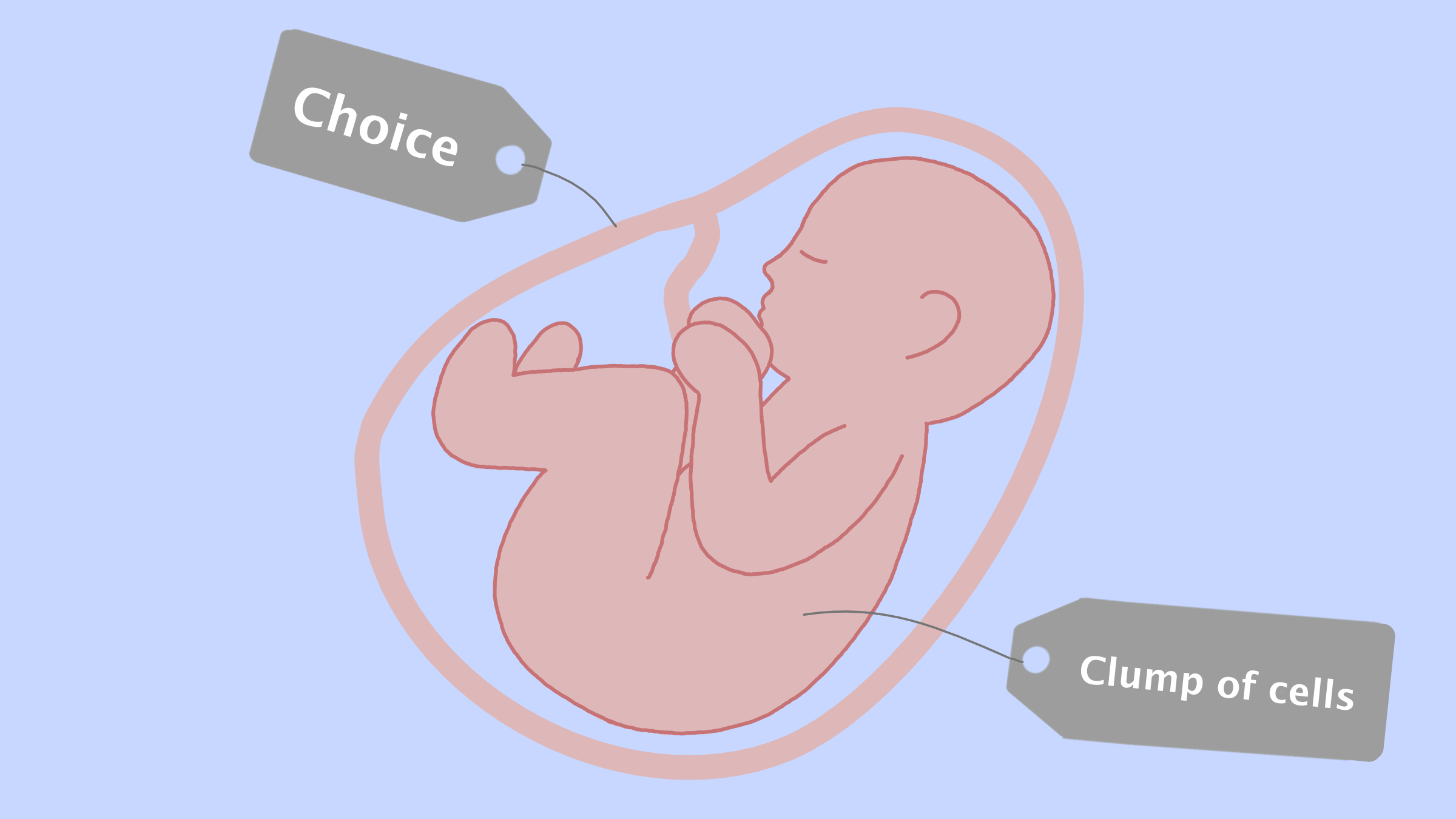
Euphemistic labelling refers to the process of presenting a harmful action as an acceptable one through the use of language by hiding the true nature of the action by using sanitised language (Bandura, 1999). For instance, the phrase “my body, my choice” focuses on the mother and refers to a concept very few people would oppose, namely an individual’s free choice, especially over her own body. However, the reference to ‘choice’ is concealing the real meaning behind the word; namely that ‘choice’ means the option to kill an unborn child. This is euphemistic because it avoids any possible negative connotations of abortion, replacing it with the concept of ‘choice’, which explains the use of the term ‘pro-choice’ rather than ‘pro-abortion’ in the labelling of the movement.
The pro-choice movement is full of euphemisms for abortion, such as “termination of pregnancy” and “reproductive healthcare”. As with the reference to ‘choice’ these terms aim to hide the true nature of the act in question, to hide the fact that it is the killing of an unborn child. This tendency is best illustrated in the objection against pro-life alternative terms for ‘abortion’ (which is an undescriptive term), such as “the killing of an unborn child”, as used in this text. Euphemistic labelling, thus, detaches the truth of the procedure from the idea of killing.
Dehumanisation
The use of euphemistic language relates to another tool for moral disengagement, namely dehumanisation, which has the effect of disengaging self-condemnation for any immoral action (Bandura, 1999). Dehumanisation aims to justify an immoral action by presenting the victim of the act as less than human. Haslam (2006) defines dehumanisation as denying someone their humanness, which takes two forms, first, by denying human characteristics, and second, by denying human nature. Human characteristics refer to attributes that distinguish humans from other species, while human nature refers to the core, fundamental characteristics of humanness (Haslam, 2006). Brennan (1996) describes this as a “semantic warfare against the vulnerable” (p. 111), which includes the dehumanisation of unborn children through various strategies. First, unborn children are presented as ‘deficient humans’ by describing them as merely ‘potential life’ (Brennan, 1996).
Second, beyond being a deficient humans, unborn children are described with language that presents them as ‘subhuman/nonhuman’ (Brennan, 1996). Examples of this include the reference to a ‘clump of cells’. The name ‘clump of cells’ may be correct to some degree, but it overlooks that the unborn child is not only a clump of cells and that these cells make up a separate human being. A ‘clump of cells’ is not necessarily a human being, but rather an animal; this being the third form of dehumanisation, namely in a ‘lower animal classification’. The lowering of an unborn child to the level of an animal is witnessed in their comparison to animals. There have been attempts in the pro-choice movements to humiliate pro-life stances by presenting an image of an animal embryo and contrasting the little visual differences to an early-stage human embryo. This comparison is degrading by dismissing the unborn child’s human nature and simplifying its implications beyond appearance.
The labelling aimed at depicting the unborn child as a ‘nonperson’ is the fourth form of dehumanisation, which denies the child’s personhood (Brennan, 1996). A term that may depict this is ‘the pregnancy’ to refer to the unborn human. This term is misleading because pregnancy refers to a time period when the child is growing in the womb and is not a reference to a person. Personhood is particularly significant in a legal context since the denial of personhood also denies the unborn child’s rights protected under the law.
Additionally, unborn children are also presented as ‘parasitic creatures’ and ‘infectious diseases, such as by referring to them as ‘tumours’ or ‘parasites’, which are both simply medically incorrect (Brennan, 1996). Some go as far as referring to an unborn child as a ‘waste product’, with terms such as ‘product of conception’, which gives the impression of an undesired consequence and merely a ‘product’. The reference to a product is dehumanising by ignoring that the product of conception is indeed a person.
From a human psychology perspective, the dehumanisation of a victim, in this case, the unborn child, is significant and necessary, since the perception of the victim as sharing in our common humanity may create a sense of empathy between the individual and the victim (Bandura, 1999). Therefore, this may explain how women and healthcare workers engaged in abortion may disengage from the act through the disregard for the unborn child of his or her humanity.
The dehumanisation of a specific group relates to the concept of infra-humanisation, which is defined as “perceiving an out-group as lacking uniquely human attributes relative to an in-group” (Haslam & Loughnan, 2014, p. 40). Distinctly human characteristics are used to describe in-group members, in this case, women, while out-group members are described as less human, in this case, unborn children (Leyens, Rodriguez-Torres, Rodriguez-Perez, Gaunt, Paladino, Vaes & Demoulin, 2001). The asymmetry in the human characteristics between the woman seeking an abortion and the unborn child can be illustrated by the attribution of pain and suffering to the woman but ignored in the case of the unborn child. Attribution of pain to individuals humanises and provides empathy to their suffering.
Haslam, Bain, Douge, Lee, and Bastian (2005) find that the dehumanisation of outgroup members does not necessarily relate to the denying of human characteristics, but rather to human nature. For example, the fact that there is no discussion about the secondary human emotions of unborn children impacts the lack of attribution of human nature to the ‘outgroup’ of unborn children (Haslam, Bain, Douge, Lee, & Bastian, 2005). Therefore, the denial of human nature has the effect of denying emotionality and agency from objects of dehumanisation (Haslam, Bain, Douge, Lee, & Bastian, 2005).
Mikołajczak, and Bilewicz (2015) specifically apply dehumanisation and infra-humanisation literature to the pro-life and pro-choice abortion questions. The authors find that the specific words used in the abortion discussion indirectly affect the support for abortion through legal and medical reasons (Mikołajczak & Bilewicz, 2015). The studies found that the particular use of the term ‘child’ rather than ‘foetus’ affects the perception of humanity (Mikołajczak & Bilewicz, 2015). Reference to the foetus gave an impression of a lack in human nature, which in turn affects the attitude towards abortion (Mikołajczak & Bilewicz, 2015). This form of dehumanisation, which Mikołajczak and Bilewicz (2015) recognise as mechanistic dehumanisation in the case of abortion, triggers emotional distancing from the unborn child and suggests indifference towards their situation (Haslam, Bain, Douge, Lee, & Bastian, 2005).
Social categorisation
A significant aspect to take into consideration in the abortion debate is group identification. There is a ‘social categorisation’, as Tajfel (1982) puts it (although not about abortion), of the pro-abortion side as a default stance for women. This implies that anyone that is against abortion must be a man, thus, gendering the issue. In the discussion of abortion, it is obvious that the case of gender is significant since abortion is related to women’s bodies. However, the gender division at the ideological level is not clear cut in the abortion debate. This dichotomy creates frictional inter-group relations, by framing abortion as a women’s issue, thus, thus men should not have a say in it. This harms the discussion on abortion by silencing men, who hold a significant role in pregnancy, namely being the fathers of the unborn children.
References
- Bandura, A. (2002). Selective Moral Disengagement in the Exercise of Moral Agency. Journal of Moral Education, 31(2), 101–119. https://doi.org/10.1080/0305724022014322
- Bandura, A. (1999). Moral disengagement in the perpetration of inhumanities. Personality and Social Psychology Review, 3(3), 193–209. https://doi.org/10.1207/s15327957pspr0303_3
- Brennan, W. (1996). The language of the Culture of Death. Catholic Social Science Review, 1, 111-123. https://doi.org/10.5840/cssr1996115
- Haslam, N. (2006). Dehumanization: an integrative review. Personality and Social Psychology Review, 10(3), 252–264. https://doi.org/10.1207/s15327957pspr1003_4
- Haslam, N., Bain, P., Douge, L., Lee, M., & Bastian, B. (2005). More Human Than You: Attributing Humanness to Self and Others. Journal of Personality and Social Psychology, 89(6), 937–950. https://doi.org/10.1037/0022-3514.89.6.937
- Haslam, N., & Loughnan, S. (2014). Dehumanization and Infrahumanization. Annual Review of Psychology, 65(1), 399–423. https://doi.org/10.1146/annurev-psych-010213-115045
- Kreps, T., & Monin, B. (2014). Core Values Versus Common Sense: Consequentialist Views Appear Less Rooted in Morality. Personality & Social Psychology Bulletin, 40(11), 1529–1542. https://doi.org/10.1177/0146167214551154
- Leyens, J-P., Rodriguez-Torres, R., Rodriguez-Perez, A., Gaunt, R., Paladino, M., Vaes, J., & Demoulin, S. (2001). Psychological essentialism and the differential attribution of uniquely human emotions to ingroups and outgroups. European Journal of Social Psychology. 81:395–411
- Mikołajczak, M., & Bilewicz, M. (2015). Foetus or child? Abortion discourse and attributions of humanness. British Journal of Social Psychology, 54(3), 500–518. https://doi.org/10.1111/bjso.12096
- Tajfel, H. (1982). Social Psychology of Intergroup Relations. Annual Review of Psychology, 33(1), 1–39. https://doi.org/10.1146/annurev.ps.33.020182.000245
- Vetlesen, A. (2019). Narratives of Entitlement. In Moral Evil in Practical Ethics (1st ed., pp. 80–102). Routledge. https://doi.org/10.4324/9780429455926-5
 Vox ad Vitam